Reasoning
12 Reasoning Tricks for Bank & SSC Exams, With Diagrams
Make seating arrangements, syllogisms, family trees, directions, and inequalities easier to follow with clear diagrams and worked reasoning examples.
By PrepExami Team · · 12 min read
A reasoning question becomes easier when you put its information somewhere you can see it. Draw the seats, mark the direction, or connect the family members before trying to hold every clue in your head.
These 12 reasoning tricks for bank and SSC exam preparation are ways to organise information and check conclusions. They cover seating arrangements, syllogisms, blood relations, coding-decoding, input-output, directions, floor puzzles, and inequalities. Use your exam's current syllabus and sample questions to decide which topics need the most practice; their weight and format vary by exam and stage.
Start with these three habits
- Choose a useful diagram. Seats need positions; family clues need a tree; directions need a compass.
- Separate facts from guesses. Mark alternative cases instead of treating your first possible arrangement as the answer.
- Check every clue. A neat diagram is only useful if it satisfies the information in the question.
1. Start seating arrangements with the most definite clue
Draw the correct number of seats first. Then choose a clue that fixes a position or a strong relationship, such as an end seat, a numbered seat, or two people directly opposite each other.
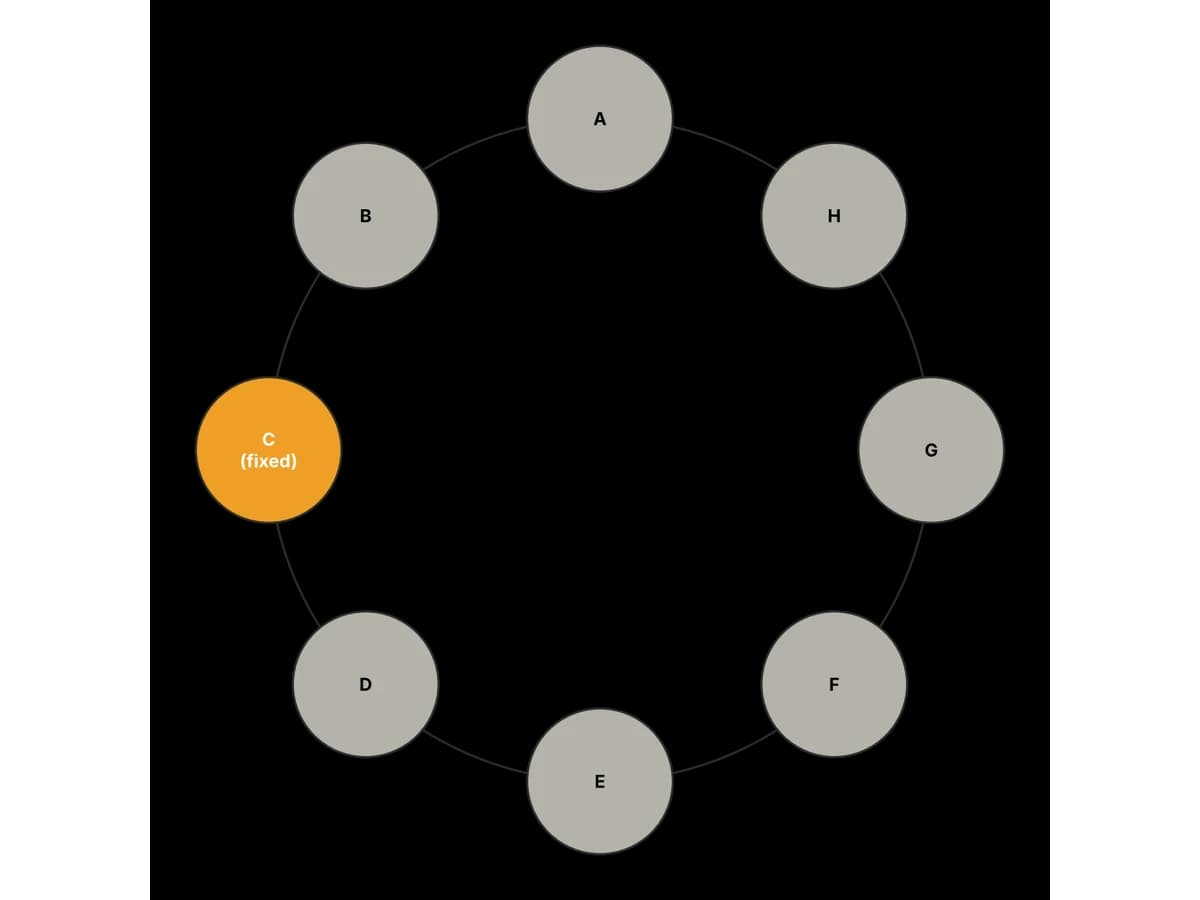
In a circular arrangement with no absolute reference point, you can put one person anywhere to anchor the drawing: rotating the whole arrangement does not change the relationships. That does not give you permission to guess everyone else's position.
For example, in an eight-seat circle, place C at one seat. If the clue says G is directly opposite C, G belongs four seats away. A clue such as "B sits next to C" may still allow two positions; keep both until another clue decides between them.
2. Work out left and right from the person's viewpoint
For people facing the centre of a circle, left is clockwise and right is anticlockwise around the circle. For people facing outwards, those directions reverse.
Check this with someone at the top of your drawing. If they face the centre, they face down the page. Their left points towards the right side of the page, which is the clockwise direction from that top seat.
In mixed-facing questions, mark a small inward or outward arrow for each person. For "B is second to the left of A," use A's facing direction and count two seat positions from A. Do not use your own left on the page.
3. Put an "all" group inside the larger group
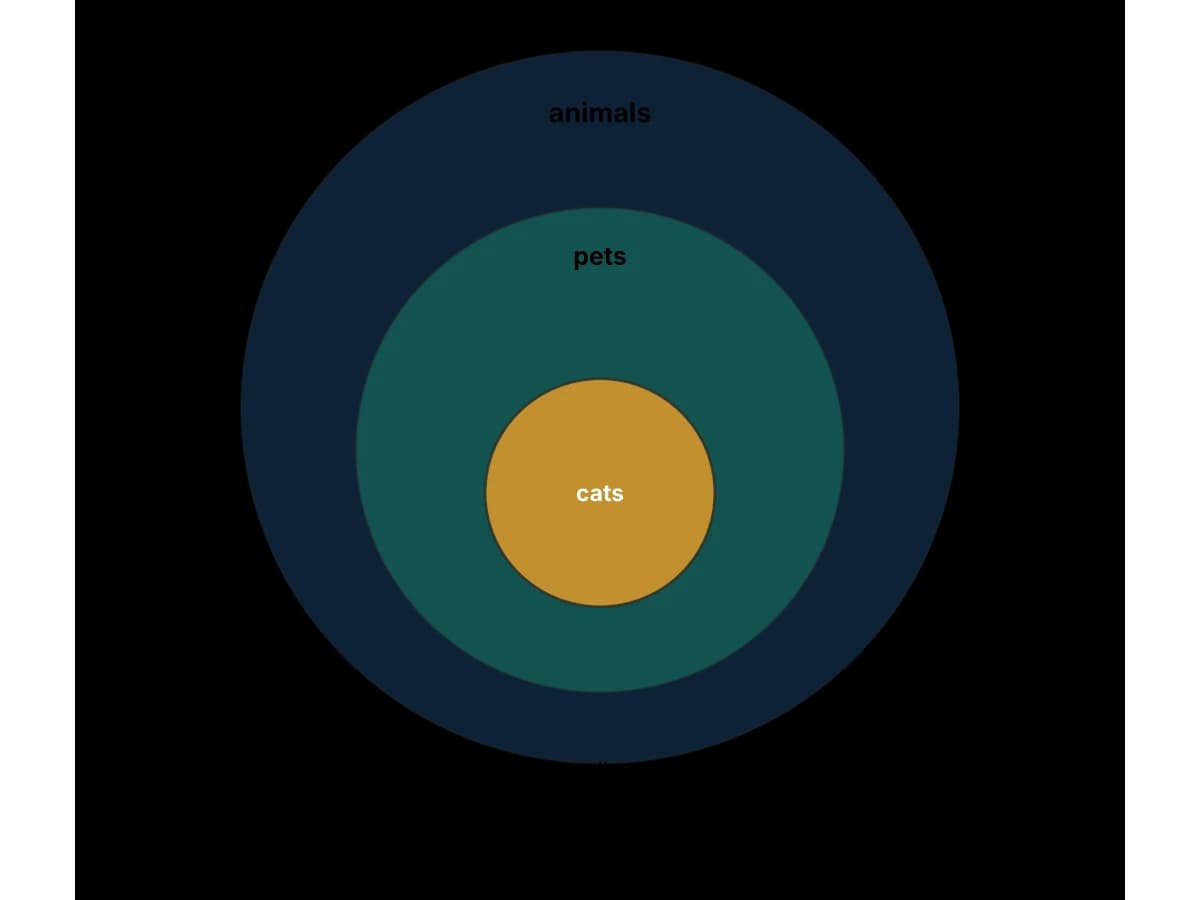
For the hypothetical statements All cats are pets and All pets are animals, put the cats circle inside pets and pets inside animals. The conclusion All cats are animals follows.
The labels in a syllogism are governed by the question's statements, even if they do not describe real life. Do not bring outside knowledge into the solution.
The chain does not reverse: "All animals are cats" does not follow. Also, universal statements alone do not establish that a group has members under standard modern logic. Follow any explicit existence convention in the test instructions rather than silently assuming one.
4. Mark "some" with a witness in the overlap
"Some cats are black" tells you that at least one thing is both a cat and black. Draw two sets and mark an X in their intersection to record that fact.
It does not tell you that some cats are not black. All cats being black is still compatible with the statement. An overlapping-circle sketch is a convenient way to record an intersection, not proof that every non-overlapping region contains something.
A useful check: from "Some A are B," you may conclude "Some B are A." You may not conclude "All A are B" or "Some A are not B" without more information.
5. Separate definite conclusions from possibilities
A definite conclusion must hold in every arrangement that satisfies the statements. One valid counterexample is enough to show that it does not follow. A possibility only needs one valid arrangement where it holds, provided it does not contradict a statement.
Suppose Some A are B and No B are C. The A that are B cannot be C, so Some A are not C follows. But other A might be C, so No A are C does not follow.
You can test that second conclusion by drawing one A inside B and another A inside C, while keeping B and C separate. The original statements remain true, but "No A are C" is false. Read whether the question asks for a definite conclusion or a possibility before answering.
6. Draw a family tree one relationship at a time
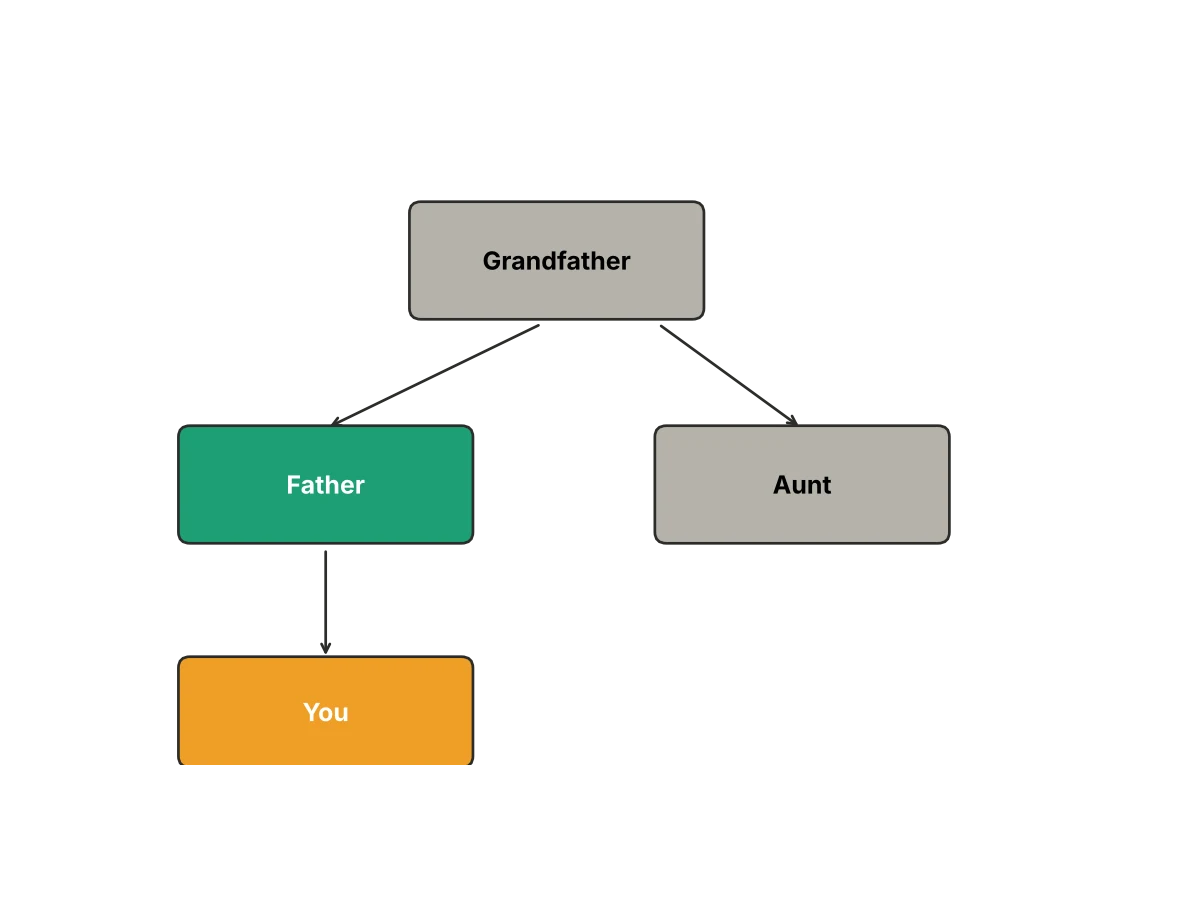
For "my father's sister," start with you, connect upwards to your father, and show his sister on the same generation line. She is your paternal aunt.
Read each relationship from its grammatical starting point. "A is B's father" means the parent-to-child line goes from A to B. Reversing that line changes the answer.
The illustration shows one example family structure. In a longer question, add only the relationships that are actually stated or necessarily implied.
7. Keep gender and generation separate
Use a consistent legend: M for male, F for female, and ? where gender is not given. Put parents above children, siblings on the same level, and use a different connector for partners.
Do not infer gender from a name. If P is Q's parent and Q is R's sister, you know Q is female, but P's gender is still unknown. If Q and R are stated to share that parent, you can add the corresponding parent link; do not invent unstated family details.
Generations also differ from ages: two siblings can be years apart while remaining on the same generation line. A small legend is more reliable than an unexplained plus or minus sign.
8. Turn alphabet shifts into arithmetic
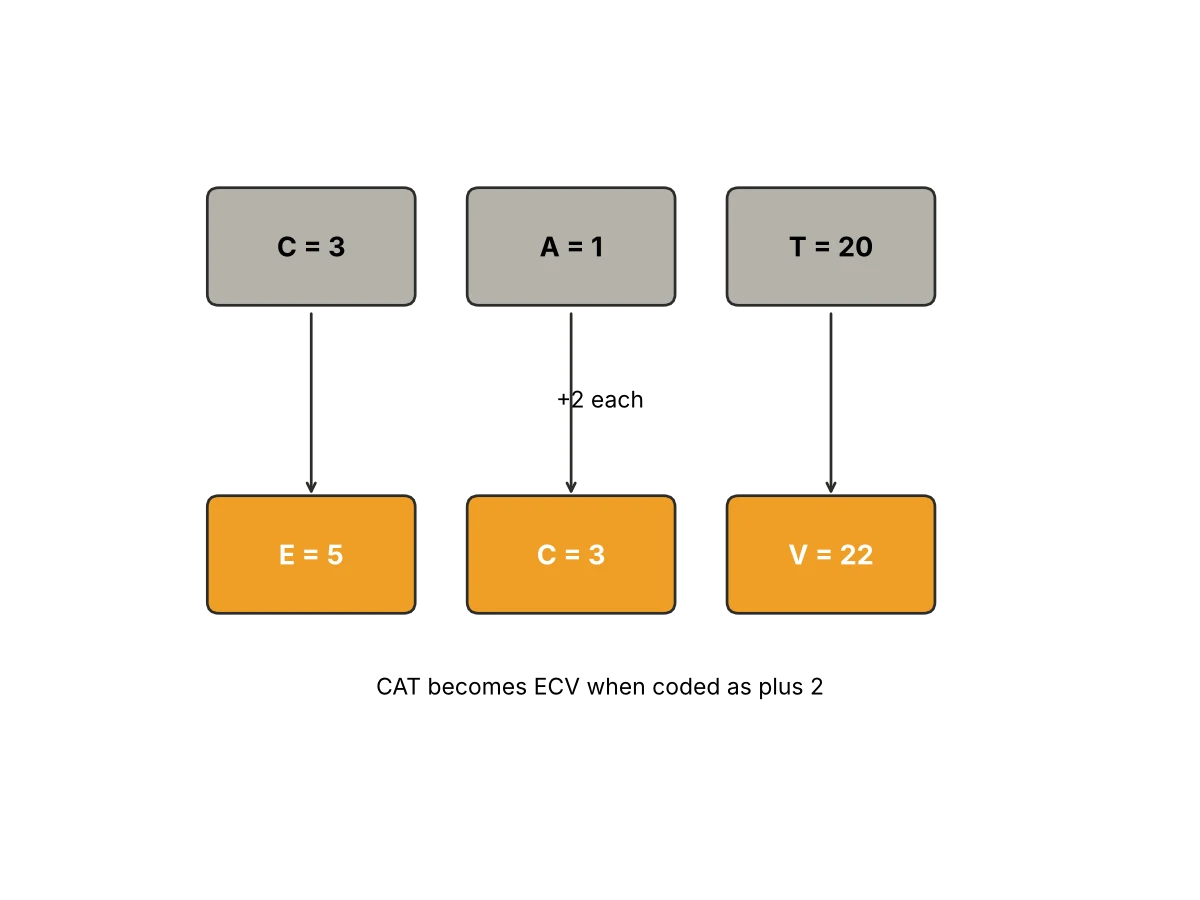
Write A = 1 through Z = 26 during practice. For CAT → ECV, the positions change from 3, 1, 20 to 5, 3, 22: each letter moves forward by two places.
Use that proposed rule on another example before committing to it. Codes can also reverse letters, alternate shifts, or use a different operation. One example may allow more than one rule.
If the rule specifies a cyclic alphabet, wrap around after Z: Y shifted by two becomes A. Do not assume wrapping or a constant shift if the question gives a different convention.
9. Track what becomes fixed in input-output questions
Compare one step with the next and mark the item newly placed at the start or end. Tracking one item can help, but also check what happens to the remaining items and whether the rule repeats.
For example, input 42, 17, 30 becomes 17, 42, 30, then 17, 30, 42. A candidate rule is to place the smallest remaining number into the next position from the left.
That short example alone may fit other rules. Check the full sequence of demonstrated steps before applying a rule to a new input. Some questions alternate between arranging words and numbers, so record both operations if needed.
10. Keep north fixed on your page
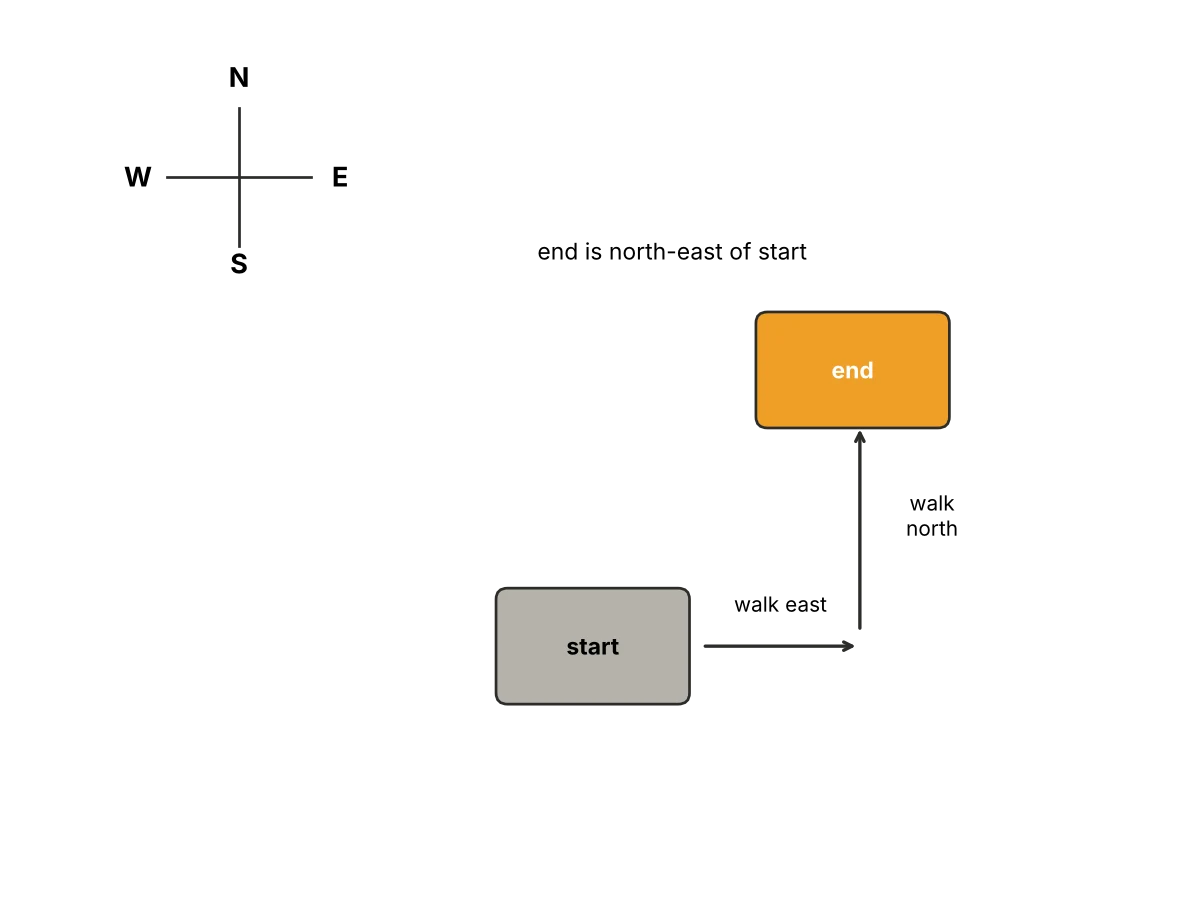
Put north at the top of your sketch and leave the compass there. The person's facing direction changes as they turn; the compass does not.
If someone walks east and then turns left, they now face north. If they walk 3 km east and 4 km north, they finish northeast of the start. Their walking distance is 7 km, while their straight-line distance from the start is 5 km, using the right-angled triangle.
Do not confuse final facing direction, displacement direction, and total distance travelled. After that route, the person faces north but is northeast of where they started. Use the turn angle stated in the question; a left or right turn is not always 90 degrees when another angle is specified.
11. Label every floor before placing people
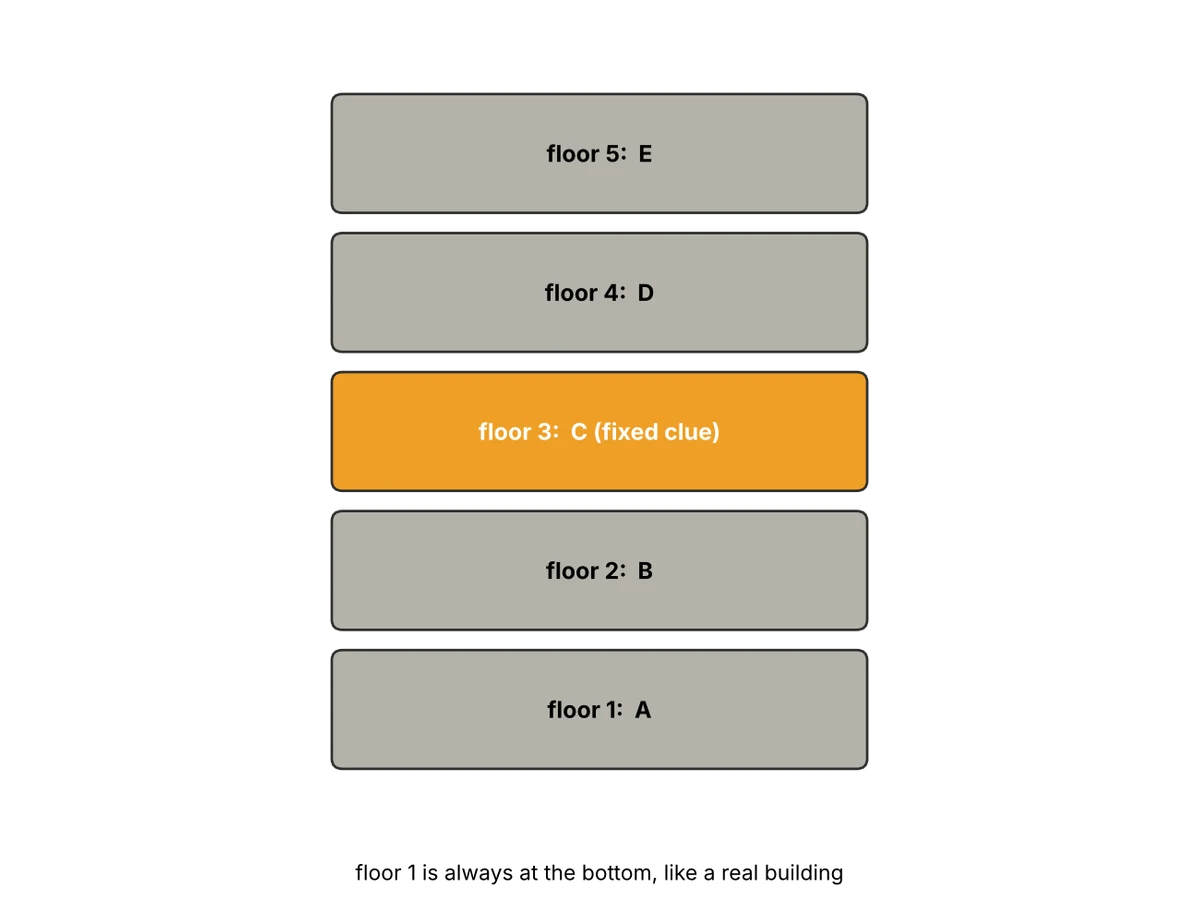
Draw a vertical grid and copy the question's numbering convention. If it says floor 1 is the bottom floor and floor 5 is the top, label the grid from bottom to top. Other questions may use a ground floor or a different convention.
Put the most specific clue in first. "C lives on floor 3" fixes a cell. "D lives immediately above C" then fixes D on floor 4. "D lives above C" alone does not necessarily mean the next floor.
The illustration shows one completed example: A on floor 1, B on 2, C on 3, D on 4, and E on 5. The first two placements need their own clues; you cannot infer them just from C and D. Keep separate grids for unresolved cases.
12. Follow an inequality chain without reversing it
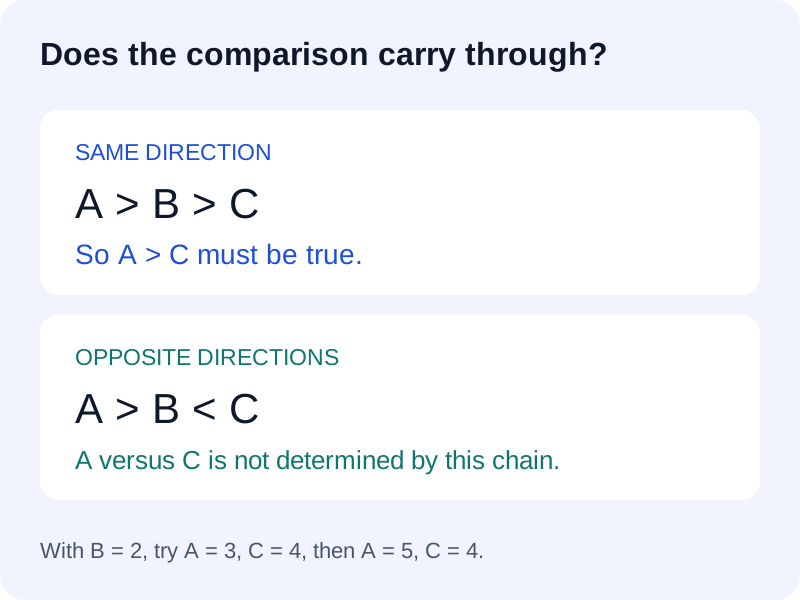
From A > B and B > C, you can conclude A > C. A chain in the same direction carries the comparison through.
Mixed strict and non-strict signs need care. From A ≥ B > C, A > C still follows. From A ≥ B ≥ C, only A ≥ C is guaranteed: all three could be equal.
For A > B < C, the relationship between A and C is unknown from those statements alone. With B = 2, A could be 3 and C 4, or A 5 and C 4, or both A and C could be 4. More clues might resolve it, but this chain does not.
Five quick checks
- A person at the top of a circle faces the centre. Is their immediate left seat clockwise or anticlockwise?
- Some A are B. Must some A be outside B?
- All A are B and all B are C. Does all A are C follow?
- A person walks 3 km east and 4 km north. What is their straight-line distance from the start?
- A ≥ B > C. Must A be greater than C?
Answers
- Clockwise. Use the seated person's viewpoint.
- No. "Some" guarantees at least one shared member; it does not exclude all A being B.
- Yes. The subset relationship passes through B.
- 5 km. The path length is 7 km, but the displacement is the hypotenuse.
- Yes. Even if A equals B, B is still greater than C.
Use a skip-and-return plan that fits your exam
During timed practice, notice when you stop making progress on a set. If the test interface and rules allow returning to questions, leave a clear diagram and move on rather than repeatedly restarting the same puzzle.
There is no universal 90-second limit. Your decision should reflect the section's time limit, marking rules, the number of linked questions, and your progress on the set. Review abandoned questions after practice to distinguish a missing method from a simple drawing error.
Common questions about reasoning preparation
Which reasoning topic should I practise first?
Check your exam's current syllabus, try a short mixed set, and start with a topic where you can identify a specific gap. Inequalities and alphabet shifts can be manageable places to build accuracy; seating and floor puzzles need practice with complete sets. The best order depends on your starting point and the exam.
Do the same methods work for bank and SSC questions?
These logical methods apply wherever the same underlying problem appears. That does not mean every exam includes every topic, or that difficulty and question formats are interchangeable. Choose practice that matches your target exam and stage.
How can I get faster at seating arrangements?
Draw seats consistently, mark facing directions, and keep unresolved cases separate. Reuse a verified arrangement across its linked questions. After a set, check whether your delay came from misreading a clue, counting seats incorrectly, or missing a useful deduction.
Is memorising shortcuts enough?
No. A method helps when you understand its conditions. Practise explaining why a conclusion follows and, when it does not, construct a counterexample. That makes it easier to spot questions where a familiar shortcut is being misapplied.
Practise the weak spot you found
Choose one topic from this guide and solve a few fresh questions. Mark the exact clue or step that caused each mistake. For more worked explanations, explore the reasoning guides, then browse exam practice.
Pair your reasoning work with speed maths tricks for bank and SSC exams and a repeatable exam study plan. If you generate a custom quiz from notes in PrepStudio, verify the questions and answers against the source before using them for revision.