Study strategies
How to Study for Exams: 9 Practical Methods and a 7-Day Plan
A practical guide to testing yourself, spacing your revision, and learning from mistakes—with a seven-day study plan you can adapt to your exam.
By PrepExami Team · · 10 min read
You sit down to revise, read a chapter, and recognise almost everything. Then you try a question without your notes and draw a blank. That gap between recognising an answer and producing it is a useful place to start.
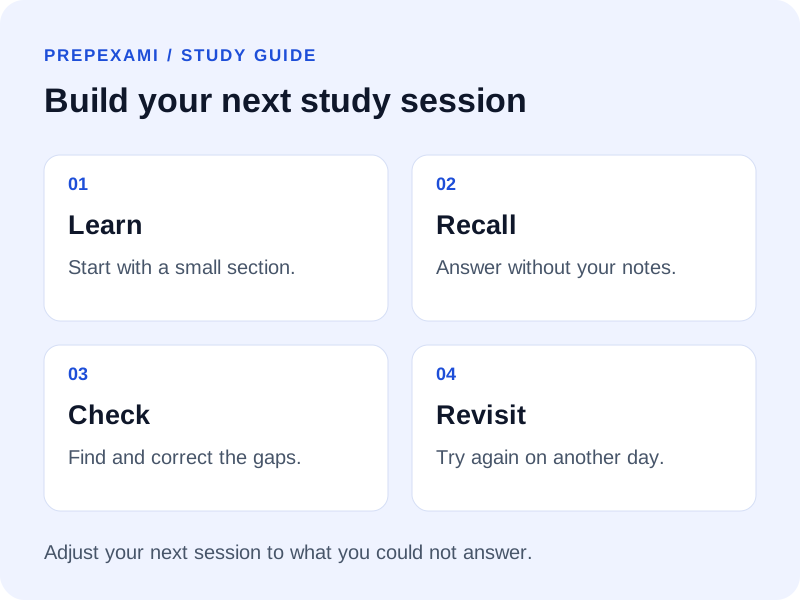
To study for exams, learn a small section, close your notes, and try to answer questions about it. Check what you missed, then return to the topic on another day. Build your plan around that routine, with practice that matches the exam you will actually sit.
Here are nine ways to make that work, followed by a seven-day example you can adapt to your own timetable.

Short on time? Start here
- Close the notes: answer a question before looking up the solution.
- Check the gap: identify what you missed and practise a fresh example.
- Come back later: put your next review in the calendar.
- Match the exam: include the question types and timing you will face.
What the research supports
A review by Dunlosky and colleagues rated practice testing and distributed practice highly across a range of learners and tasks. Rereading and highlighting received lower ratings as standalone learning techniques. That does not mean you should never read a chapter twice or make a summary. It means those activities are usually an incomplete revision plan.
The nine steps below combine those findings with practical ways to organise your work. They are not nine equally proven treatments, and no timetable can promise a particular score.
1. Check what the exam will ask you to do
Before making a schedule, find the current syllabus, assessment guidance, and a sample or past paper from your teacher or exam provider. Check the question types, time available, and marking rules.
Make a short topic list. Beside each topic, write one of three labels: can answer independently, need practice, or need to learn. Try a few questions before deciding; familiar-looking notes can make a topic feel easier than it is.
Your practice should match the task. For an essay exam, write an argument and support it with evidence. For maths, solve unfamiliar problems. For multiple-choice exams, explain why the other options are wrong as well as choosing an answer.
2. Close your notes and retrieve the answer
Active recall means trying to bring information to mind before looking it up. You might write a definition, draw a labelled diagram, solve a problem, or explain the steps in a process.
For example, after studying percentages, put the worked example away and answer: a price rises from 80 to 92; what is the percentage increase? Then check both your answer and your choice of starting value.
In Roediger and Karpicke's study of learning from prose, retrieval practice improved retention on delayed tests compared with repeated studying. The practical lesson is to give yourself opportunities to answer, rather than only opportunities to read.
If you need prompts, you can turn notes into flashcards. Check generated cards against your source material, and keep each card focused on one question.
3. Return to the topic on another day
Spaced practice means spreading your work across separate sessions. Instead of declaring a topic finished after one long sitting, put a follow-up session in your calendar.
A starting example is to revisit something tomorrow, a few days later, and again the following week. These are planning examples, not a scientifically optimal sequence for every student. Bring the next review closer if you cannot answer; leave a longer gap when you can explain and apply the idea reliably.
Start each review with a question. That tells you whether you need to relearn the material or move on to a harder example.
4. Mix related question types once you know the basics
Working through ten questions that all use the same formula gives you a clue before you even read each problem. A mixed set asks you to decide which method fits.
Once you have learnt individual methods, try mixing related problems: percentages, ratios, and averages, for example. Explain why you chose a method before doing the calculation. Interleaving can help in some learning situations, but it is not a reason to switch randomly between subjects every few minutes.
If every mixed question feels unfamiliar, return to a worked example and a few focused questions first. You can find topic-based starting points in the PrepExami learning hub.
5. Explain the reasoning, not just the answer
Choose one answer and talk through it as if you were helping a classmate. Why does that step follow? When would the method fail? What changes if the question gives you a different starting condition?
For a history topic, explain a cause and a consequence. For a science topic, connect a definition to an example. For an equation, explain what the symbols represent and which assumptions you are using.
Check your explanation afterwards. A confident explanation can still contain a mistake, so use your textbook, marking guide, or teacher's feedback to verify it.
6. Keep a short error log
After practice, record mistakes you are likely to repeat. You do not need to copy every question into a second notebook.
A useful entry might look like this:
- Question type: percentage change.
- What went wrong: divided by the new value rather than the original value.
- Correction: change divided by original value, multiplied by 100.
- Next check: solve a different percentage-change question in the next session.
Separate knowledge gaps from misreading, calculation errors, and time pressure. Each needs a different response. If you guessed correctly, note that too; the score alone will not reveal the gap.
7. Practise with a timer, then leave time to review
Use timed practice to find out whether you can complete the required work at the right pace. Start with a section if a full paper would be premature. Later, use an official or representative paper under the exam's rules.
There is no universal quota of mock tests. Choose a frequency that leaves enough time to understand errors and practise the weak areas before your next attempt. Taking another paper immediately can repeat the same problems without fixing them.
Keep repeated-paper scores separate from fresh-paper scores. Remembering an answer is different from solving an unfamiliar question. For competitive-exam preparation, browse the available exam practice and check that the questions fit your syllabus and level.
8. Make a plan small enough to follow
Replace a task such as "revise chemistry" with something you can finish and check: "answer six questions on bonding, mark them, and explain the two weakest answers."
Decide what fits around your classes, work, and other responsibilities. Leave spare time for difficult topics and missed sessions. A packed timetable that depends on every day going perfectly is hard to recover from.
As an example, a 40-minute session could contain five minutes of recall, twenty minutes of questions, ten minutes of checking, and five minutes to note your next task. Change those timings to suit the work; they are not a rule about attention or learning.
9. Give sleep a place in the timetable
Set a stopping point for evening revision instead of leaving sleep to whatever time remains. Prepare what you need for the next day so you are not still arranging notes or checking exam details late at night.
The US National Heart, Lung, and Blood Institute explains that sleep supports learning and the formation of long-term memories. An all-nighter is a poor default study plan. If time is short, prioritise the most important gaps rather than trying to cover everything overnight.
A seven-day exam study plan you can adapt
This example assumes you have already started the course material. It is a way to organise a week of revision, not a promise that an entire syllabus can be learnt in seven days.
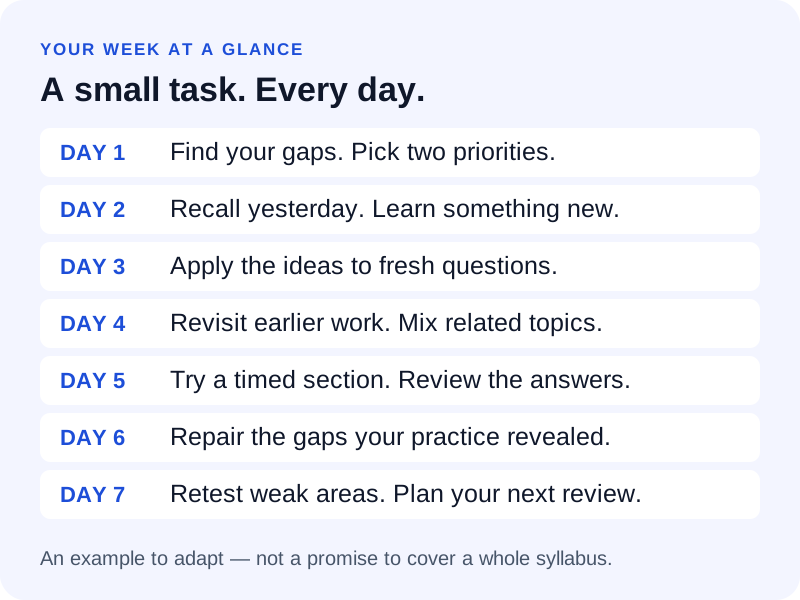
- Day 1 — Find your starting point. Check the syllabus and try a short diagnostic set. Pick two priority topics. Learn or refresh the first one, then answer questions without notes.
- Day 2 — Recall and extend. Retest yesterday's topic before checking your notes. Work on the second priority topic and start an error log.
- Day 3 — Apply. Try new problems on both topics. Explain how you chose each method. Relearn any missing foundations.
- Day 4 — Revisit. Return to Day 1's material. Mix related question types and check whether earlier mistakes recur.
- Day 5 — Practise timing. Complete a timed section that reflects your exam. Review the answers and identify the main cause of lost marks.
- Day 6 — Repair the gaps. Work on those causes. Use fresh questions to check whether your correction holds up.
- Day 7 — Check and plan. Retest selected weak areas. Schedule next week's reviews. If the exam is tomorrow, keep the final review manageable and prepare your materials.
What if the exam is tomorrow?
First, stop trying to build a perfect long-term plan in one evening. Check which topics matter most for this exam and choose a manageable set of gaps.
Use short question-and-check cycles. Look up what you cannot answer, work through an example, and try a fresh question. A concise summary can help you locate material quickly, but spend some of the remaining time answering without it. Confirm the exam time, location, and required equipment, then leave room for sleep.
Common questions about studying for exams
How many hours a day should I study?
There is no single number that fits every course, exam date, or starting point. Plan around the tasks you need to complete and the time you realistically have. Check progress by what you can answer independently, not just by hours at your desk.
Should I stop highlighting and making summaries?
No. Use them when they help you organise or understand a first reading. Then turn important points into questions and try answering from memory. A tidy set of notes is useful, but it is not a test of what you can do unaided.
Do these methods work for essay exams?
Recall can help with facts, definitions, and examples, but an essay also needs reasoning and structure. Practise planning and writing answers to actual prompts. Compare your work with the assessment criteria and ask for feedback where possible.
Can I use AI to make practice questions?
Yes, as a source of practice material that you check. You can generate questions from a PDF, then compare the answers with your notes or textbook. AI-generated questions may contain errors or miss parts of the syllabus. They should supplement course guidance and official papers.
Start with one topic today
Pick something you studied recently. Close your notes and answer three questions about it. Check the answers, write down the gap that matters most, and choose a day to revisit it.
If you already have notes ready, create flashcards from them. If you need a practice starting point, explore the learning hub. You do not need to overhaul every study habit before you can make your next session more useful.