Quantitative aptitude
15 Speed Maths Tricks for Bank & SSC Exams, With Examples
Learn practical calculation shortcuts with clear diagrams, worked examples, common mistakes, and five questions to test yourself.
By PrepExami Team · · 11 min read
You do not need a shortcut for every question. You need a few reliable methods, the habit of spotting when they apply, and enough practice to use them without losing accuracy.
This guide covers 15 speed maths tricks and practice habits for bank and SSC exam preparation. Each calculation has a worked example. The last two tips help you turn the methods into a revision routine rather than a list of formulas you forget.
The shortcuts at a glance
- Multiplication: use place value, nearby squares, and numbers ending in 5.
- Percentages: switch to exact fractions where possible and apply successive changes one at a time.
- Word problems: write the units and assumptions before choosing a formula.
- Practice: check accuracy first, then work on speed with fresh questions.
These examples teach arithmetic methods; they are not a claim about the current syllabus or question distribution of any particular exam. Use your exam's official guidance to choose what to practise.
1. Multiply a two-digit number by 11
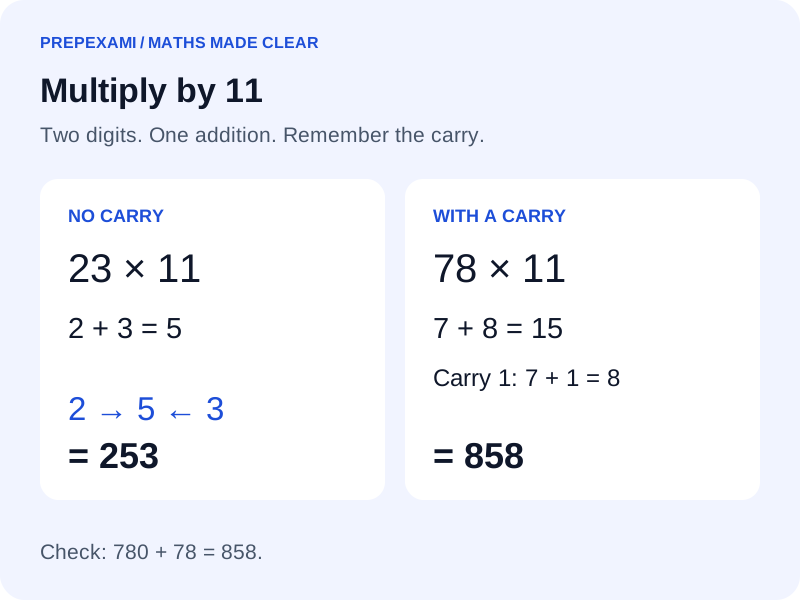
For 23 × 11, add the digits: 2 + 3 = 5. Put that sum between the original digits to get 253.
The reason is place value: 23 × 11 = 230 + 23. The middle-digit shortcut just compresses that addition.
Watch the carry: for 78 × 11, the digit sum is 15. Put 5 in the middle and carry 1 to the hundreds: (7 + 1), 5, 8 → 858. Writing 7158 would be wrong.
2. Multiply numbers equally spaced around an easy number
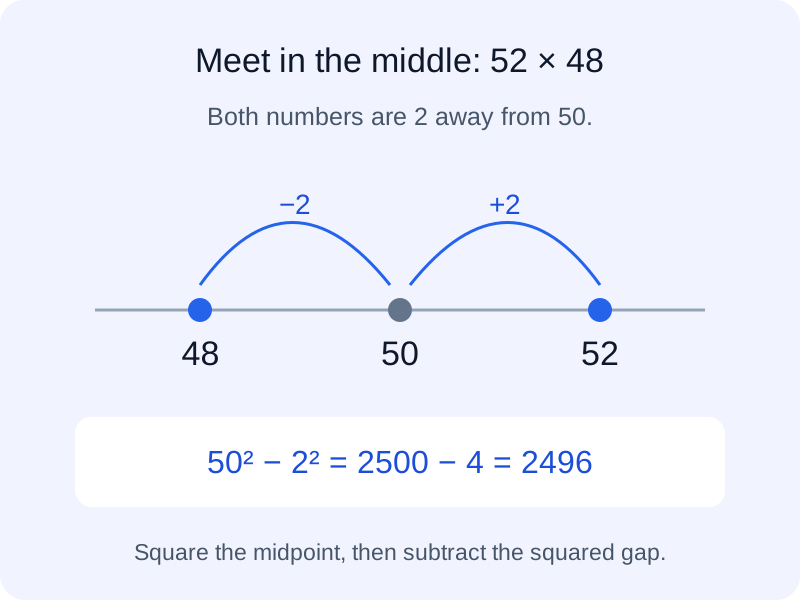
For 52 × 48, notice that the numbers are 50 + 2 and 50 − 2. Use (a + b)(a − b) = a² − b².
52 × 48 = 50² − 2² = 2500 − 4 = 2496.
The same idea gives 103 × 97 = 100² − 3² = 9991. It is most convenient when the midpoint is easy to square. Do not subtract the gap just once; you need its square.
3. Divide by 9 using a nearby multiple
Replace a vague approximation with a multiple you can check. For 437 ÷ 9, use 9 × 48 = 432. The difference is 5, so the answer is 48 remainder 5, or 48 + 5/9.
For 729 ÷ 9, split 729 into 720 + 9. Then 80 + 1 = 81.
A digit sum can help check divisibility: 7 + 2 + 9 = 18, which is divisible by 9. It does not tell you the quotient. Keep a remainder unless the question asks for a decimal or an approximation.
4. Square a whole number ending in 5
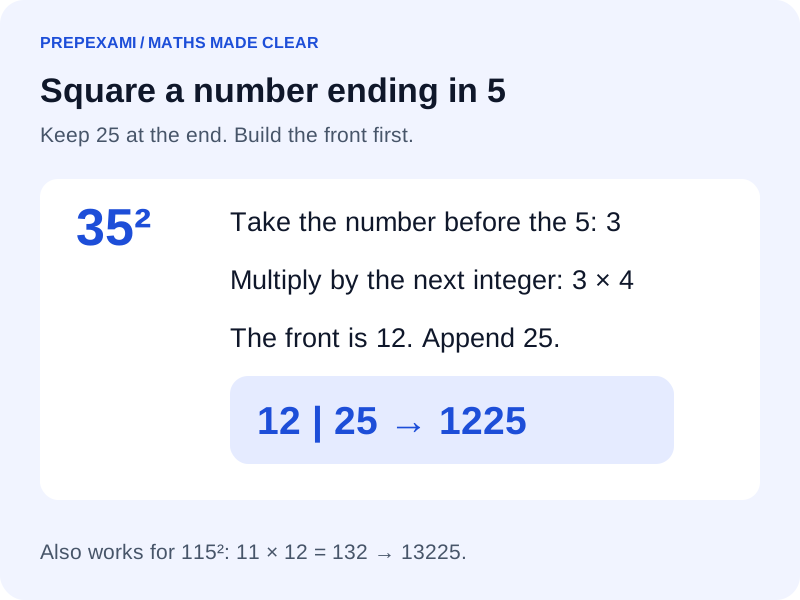
Remove the last 5, multiply the remaining number by its next integer, and append 25.
- 35²: 3 × 4 = 12 → 1225.
- 85²: 8 × 9 = 72 → 7225.
- 115²: 11 × 12 = 132 → 13225.
This works for positive whole numbers ending in 5 because (10n + 5)² = 100n(n + 1) + 25. The number before the 5 can have more than one digit.
5. Swap familiar percentages for exact fractions
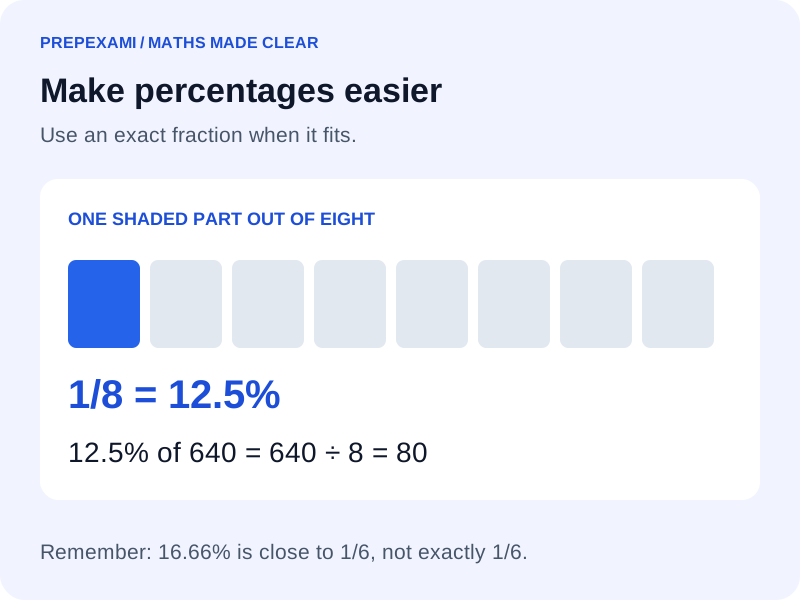
It is often easier to divide than to multiply by a decimal. For example, 12.5% of 640 = 640 ÷ 8 = 80.
- 50% = 1/2. Divide by 2.
- 25% = 1/4. Divide by 4.
- 12.5% = 1/8. Divide by 8.
- 20% = 1/5. Divide by 5.
- 16⅔% = 1/6. Divide by 6.
- 33⅓% = 1/3. Divide by 3.
Exact and rounded values are different. 16⅔% of 480 is exactly 80, but 16.66% of 480 is 79.968. Similarly, 33.33% is close to one-third, not exactly equal to it. Use an approximation only when the question permits it.
6. Apply successive discounts to the reduced price
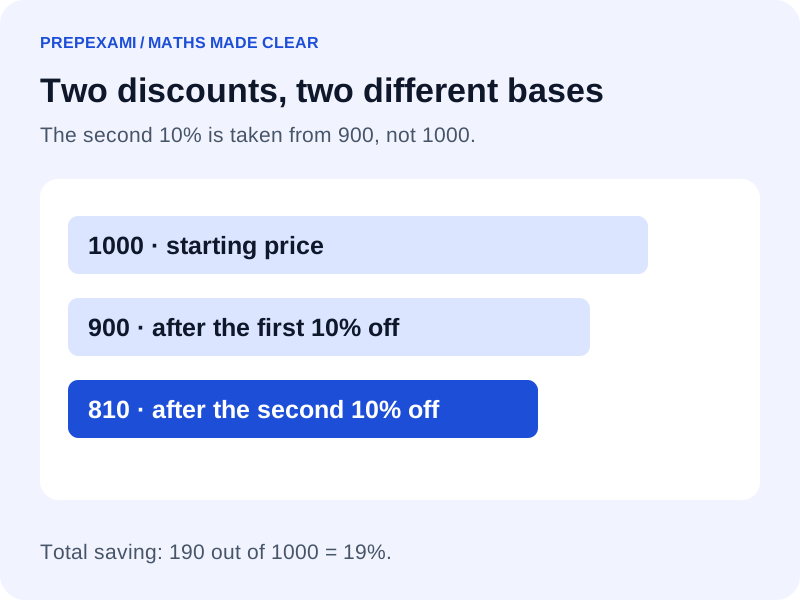
A 10% discount followed by another 10% discount gives 19% off overall, not 20% or 21%.
Start with a price of 1000. After the first discount, it is 900. The second discount is 10% of 900, which is 90, leaving 810. You saved 190 out of 1000.
For two discounts of a% and b%, the equivalent discount is a + b − ab/100 percent. For 10 and 10, that is 10 + 10 − 1 = 19%.
The second percentage uses a new base. Two successive 10% increases produce a 21% increase, which is a different calculation.
7. Find the difference between compound and simple interest over two years
For the same principal P and annual rate r%, with annual compounding, a fixed rate, and no additional payments, the two-year difference is P × (r/100)².
If P = 5000 and r = 10, the difference is 5000 × 0.1² = 50. Simple interest is 1000; compound interest is 1050.
Why? The first year's interest is 500. Under annual compounding, that 500 also earns 10% in year two, adding 50. This shortcut is for two years under those assumptions; do not reuse it unchanged for three years or a different compounding frequency.
8. Convert the rate and periods for half-yearly compounding
When a question gives a nominal annual rate compounded half-yearly, divide the rate by 2 and multiply the number of years by 2.
For 10000 at a nominal annual rate of 10%, compounded half-yearly for one year, each period uses 5% and there are two periods.
Amount = 10000 × 1.05 × 1.05 = 11025. Interest = 1025.
Do not simply halve an effective annual rate: that is a different kind of rate. Read the wording before converting it. These are exam arithmetic examples, not investment comparisons.
9. Check the pattern family in a number series
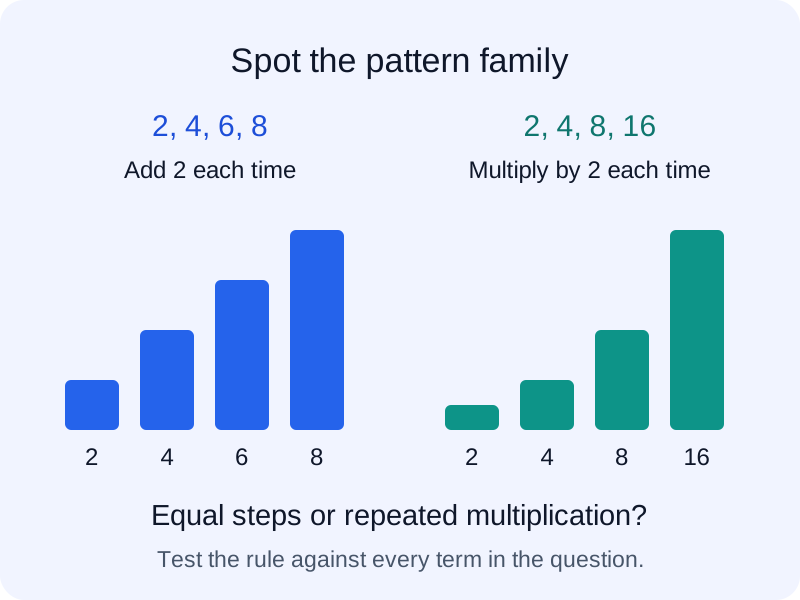
Before guessing the next term, test a few simple possibilities: equal differences, repeated multiplication, changing differences, or alternating subsequences.
- 2, 5, 8, 11: add 3 each time; the natural next term is 14.
- 3, 6, 12, 24: multiply by 2; the natural next term is 48.
- 2, 5, 10, 17: the gaps are 3, 5, 7; continuing with 9 gives 26.
Check your proposed rule against every displayed term. A short series can fit more than one mathematical rule, so use the question context and answer choices rather than claiming a unique answer from too little information. For more examples, explore the reasoning guides.
10. Simplify in the correct order
Deal with brackets and powers first. Multiplication and division have equal priority and are handled from left to right. Addition and subtraction also share a priority and are handled from left to right.
For 24 ÷ 6 × 2 + 3, calculate 4 × 2 + 3, then 8 + 3 = 11. Doing 6 × 2 first would change the expression.
You can regroup terms when algebra allows it, but not simply because a part looks easy. Write a line of working if it helps preserve signs, brackets, or fraction boundaries.
11. Find an average using a convenient starting value
For 48, 52, 49, and 55, choose 50 as a starting value. The differences are −2, +2, −1, and +5. Their total is 4, so the average difference is 4 ÷ 4 = 1.
Average = 50 + 1 = 51.
This is especially handy when the values cluster around a round number. It is an ordinary, equally weighted average; if the groups have different sizes, account for those weights.
12. Turn time-and-work fractions into units
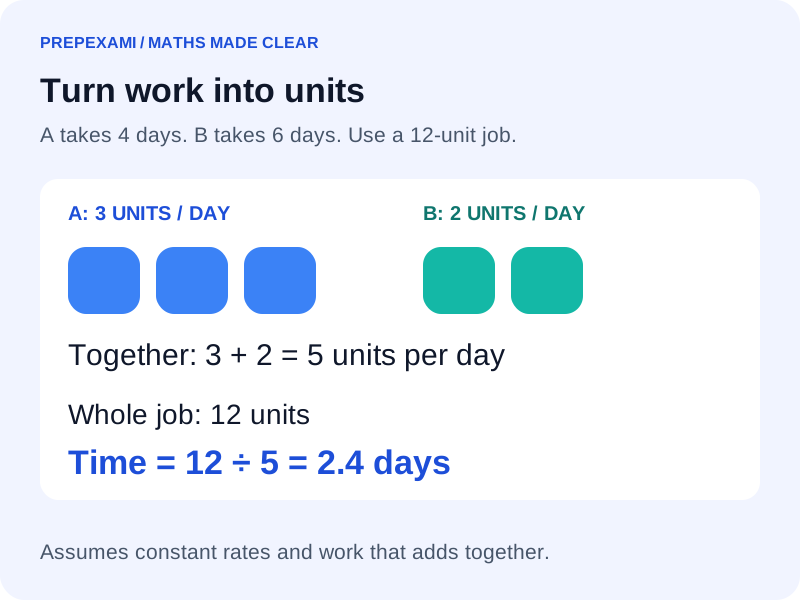
If A finishes a job in 4 days and B in 6 days, choose 12 units of work, the least common multiple of 4 and 6.
A completes 3 units per day; B completes 2. Together they complete 5 units per day, so they need 12 ÷ 5 = 2.4 days.
This assumes steady rates and that their work adds without interference. Do not automatically convert 0.4 working days into clock hours unless the question tells you how many working hours a day contains.
13. Keep boat speed and stream speed separate
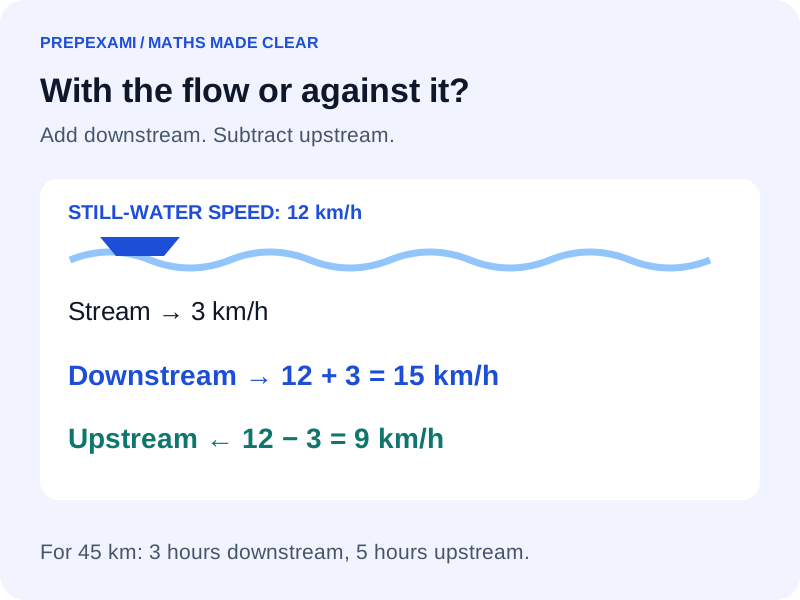
Let b be the boat's speed in still water and s the stream's speed. Then downstream speed = b + s and upstream speed = b − s.
With b = 12 km/h and s = 3 km/h, the speeds are 15 km/h downstream and 9 km/h upstream. Travelling 45 km takes 3 hours downstream and 5 hours upstream.
You can also work backwards: boat speed is half the sum of the downstream and upstream speeds; stream speed is half their difference. These rules assume constant speeds along the stream. Upstream travel requires b to be greater than s.
14. Make a one-page revision sheet
Collect the methods you actually use, not every shortcut you can find. Include one worked example and one warning beside each rule: carry for ×11, exact versus rounded percentages, and the assumptions behind interest formulas.
Use the sheet while preparing. Do not take it into an exam unless the exam rules explicitly allow reference material. Test yourself without looking at it so that recognising a formula does not replace remembering it.
For a wider revision routine, read how to study for exams.
15. Choose a method, then check whether it helped
Before calculating, ask whether the numbers fit a familiar pattern. If they do, use the shortcut. If they do not, start a dependable standard method rather than spending the whole question hunting for a trick.
A useful practice routine is to solve a small set carefully, review every error, and then try a fresh set with a timer. Record both correct answers and completion time. Repeating the same questions can make you faster at remembering answers without improving your calculation skills.
Try these five questions
- What is 67 × 11?
- What is 65²?
- What is 12.5% of 960?
- A price of 2000 is discounted by 20%, then 10%. What is the final price?
- A and B finish a job in 8 and 12 days respectively. How long do they take together at constant rates?
Answers and quick checks
- 737. The digit sum is 13: carry 1 and place 3 in the middle.
- 4225. Multiply 6 by 7 and append 25.
- 120. Divide 960 by 8.
- 1440. Calculate 2000 × 0.8 × 0.9. The combined discount is 28%.
- 4.8 days. Use 24 units: daily rates are 3 and 2, so time is 24 ÷ 5.
Common questions about speed maths
Are shortcuts enough for bank and SSC maths preparation?
No. They can shorten suitable calculations, but you still need to understand the problem, choose the right operation, and practise the topics your exam assesses. A shortcut that does not fit is slower than a standard method you know well.
Which tricks should a beginner learn first?
Start with percentage-fraction conversions, multiplying two-digit numbers by 11, and squaring whole numbers ending in 5. Check the examples without a timer first, including cases that involve a carry or a rounded percentage.
Should I approximate every calculation?
No. Approximation is useful when the question asks for it or when a safe bound clearly separates the options. Close answer choices and exact-answer questions may require the full calculation. Keep track of every rounding step.
Put the methods into practice
Choose two methods and try them on questions you have not seen before. Browse exam practice, or generate practice questions from your notes. Check generated questions and answers against your source material before relying on them.
Aim for a method you can explain and repeat accurately. Speed can then come from familiarity, rather than from skipping the part that makes the answer correct.